- Allerton Health Centre, Belldean Road, Bradford, BD15 7WA
- enquiries@myskyn.co.uk
Call Now 01274 921 121

Many of us have skin tags, and although these benign skin lesions are harmless, they can be unsightly and irritating, especially if they are highly visible or catch on clothing and jewellery.
Dr Qureshi, or our consultant plastic surgeon, Professor Sharif Al-Ghazal, will examine your skin lesion using dermoscopy to confirm that it is a benign skin tag and then discuss removal with you.
Skin tag removal at MySkyn Clinic is typically performed with cryotherapy or minor surgery.

Skin tags are benign growths that hang off the skin. They are small, typically between 2mm and 5cm in size.
Skin tags can be the same colour as the rest of your skin or slightly darker.
They contain a bundle of collagen fibres and blood vessels, which is surrounded by a thick layer of skin cells.
It is common for people to develop multiple skin tags, and they are commonly found in skin folds or in places where the skin rubs together, for example,
We can remove skin tags from anywhere on the face or body.
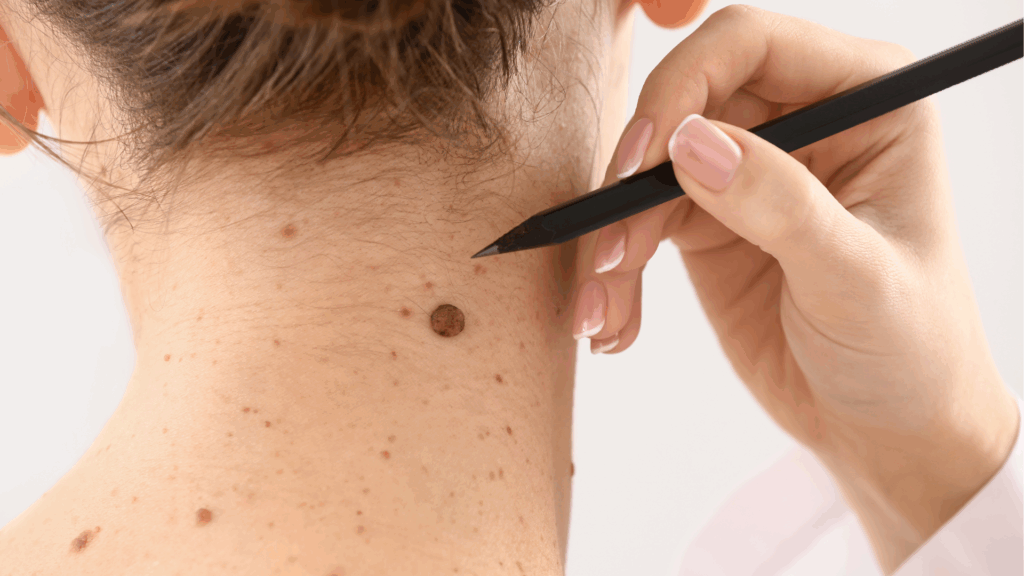
The cause of skin tags is not completely understood, but there seem to be some factors that encourage their development:
Skin tags can be left if they don’t worry you, but many people choose to have them removed for the following reasons.
It is important to check that your lesion is correctly identified as a skin tag before proceeding with treatment.
Therefore, your first step towards being skin tag-free is to consult Dr Qureshi or our consultant plastic surgeon, Mr Sharif Al-Ghazal, who will examine your skin and then recommend the best removal technique.
At MySkyn, we use two techniques:
Liquid nitrogen is sprayed onto the lesion, freezing it. One or more sprays may be required depending on the size of the skin tag.
You may feel a slight burning sensation while the liquid nitrogen is applied, but this is brief, and discomfort is minimal.
The cells within the skin tag will be destroyed by the low temperature, the tag will start to shrivel and then fall off a few days later.
Your skin may blister for a few days after cryotherapy, but most patients find that it returns to normal within a week.
Cryotherapy is highly effective at removing small skin tags.
This is a minor surgical procedure in which the skin tag is removed with sterile surgical scissors or a scalpel.
A local anaesthetic is used to numb the area before the procedure begins.
Excision results in a small, superficial wound. This will form a scab and heal within a week.
A dressing is not usually required, but we may apply one if your skin tag is in an area prone to friction, such as under the armpit.
In that case, a small dressing will be applied to protect the scab from being rubbed.
Excision is the preferred removal method for larger skin tags.
Whether you have your tag removed with cryotherapy or excision, the resulting wound will be small and will heal within a week with correct aftercare.
We advise patients to do the following to ensure rapid healing:
Don’t hesitate to contact us if you have any concerns.
Skin tag removal is a very safe and effective procedure, especially when performed by a highly experienced medical professional like Mr Al-Ghazal.
No removal is a personal choice. Most skin tags can be safely left alone, but many patients choose to have them removed because they simply don't like them. Some skin tags regularly catch on jewellery or clothing because of their location. This friction can cause bleeding and irritation, which is a good reason for removal.
No, skin tags do not disappear spontaneously; they will need to be removed if you are unhappy with them.
It may be possible to remove small skin tags at home, but we don't recommend it. Even a small skin tag can bleed, and infection is always a risk.
It is best to leave it to the professionals!
Yes, our consultant plastic surgeon routinely performs skin tag removal on delicate, sensitive areas, including the eyelids.
Yes, it is possible to remove more than one skin tag in one session. Mr Al-Ghazal will discuss this with you at your consultation.
If you look very closely at the treatment site, you may be able to detect a slight difference in the skin colour, but the blemish will be barely visible and certainly far less noticeable than a skin tag.
Skin tag removal is a very safe procedure, and when performed by a medical professional, the risks are minimal.
Mr Al-Ghazal’s expertise in skin tag removal, along with the high standards of hygiene and patient care at our clinic, ensures you are protected against complications and can expect an excellent outcome from your procedure.
Once it has been removed entirely, your skin tag will not grow back. However, if you are predisposed to developing skin tags, then more may appear in the same area.
Some risk factors, like excess weight and diabetes, can often be managed, but the cause is usually unknown, and it may be difficult to prevent the development of more skin tags.
